Master everyday life. Playfully
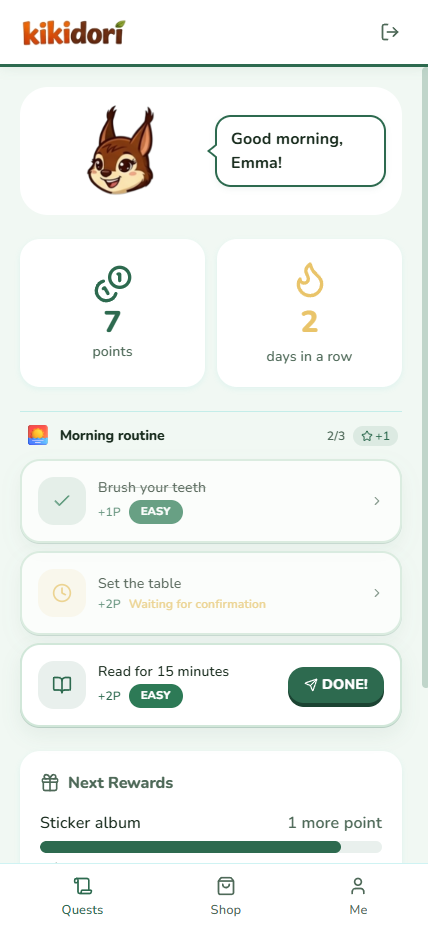
Kikidori helps children master everyday routines playfully and on their own, with clear steps, positive feedback and without punishment mechanics. It takes the constant reminding and negotiating off your plate and lightens everyday life for the whole family, especially when it gets challenging, for example with ADHD or on the autism spectrum.
Built on proven principles
Kikidori draws on the reinforcement principle that has long been used in supporting ADHD and autism, here as a practical everyday tool, not as therapy. Children are driven by their own motivation, not by pressure or punishment. More on the scientific background in the FAQ.
Tap to enlarge
Fewer arguments.
More joy.
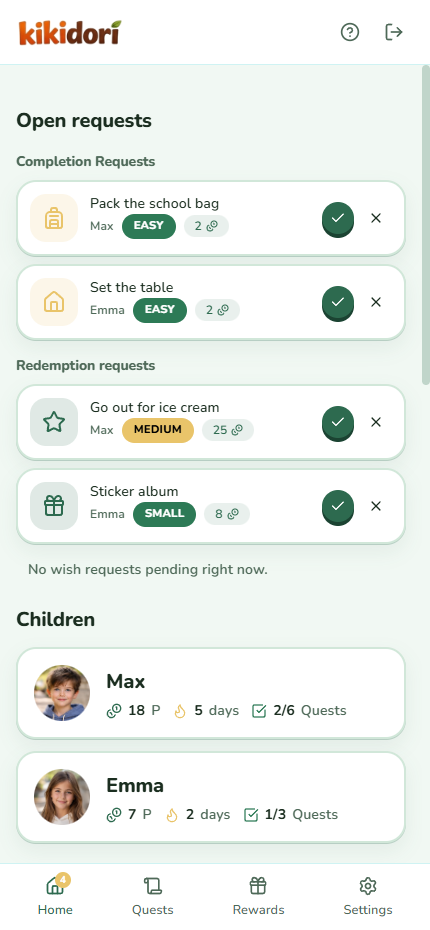
Create tasks, track progress, celebrate small wins together, accompanied by our digital mascots Kiki and Dori, instead of negotiations at the breakfast table. Both parents see the same picture, so no one carries it alone.
Tap to enlarge
How we protect your child’s data
As parents, we wouldn’t use a product that sells, tracks or stores our child’s data longer than necessary. That’s why we built Kikidori to exactly this standard, for our own daughter.
Diagnosis data stays only on your device
If you enter a diagnosis during setup, it only helps us show suitable suggestions for tasks and rewards. It never reaches our database.
Children sign in with a PIN
No email, no password, no social logins. We don’t need any personal data for your child’s login.
No ads, no trackers, no selling
We’re funded solely through Premium subscriptions. No third-party analytics, no ad networks, no data sharing.
Servers in Germany, GDPR by default
Kikidori runs exclusively on German infrastructure.
The family behind Kikidori

We’re a family with a neurodivergent daughter, who brings us a lot of joy and at the same time presents us with challenges we didn’t know before.
For a long time we relied on a sticker chart with smiling faces for completed tasks.
We wanted to carry that positive experience into the digital world: more practical in everyday life and with a clearer link between tasks and rewards.
Because we work professionally in software development and data protection, we built Kikidori for ourselves. Data protection and a genuinely child-friendly design were especially important to us, implemented as rigorously as we’d want it for our own daughter.
Now we want to make Kikidori available to all families who face similar everyday challenges, whether your child has a diagnosis like ADHD, autism spectrum or F91.3 (oppositional defiant disorder), or you’re simply looking for more calm in daily life.
Simple and fair
The everyday core is free, and always will be.
Premium is optional, free for everyone during the beta.
Free
The complete everyday core
- ✓Tasks and routines
- ✓Up to 3 custom rewards active at a time
- ✓Wish rewards from your child
- ✓All 7 themes & animated celebration moments
- ✓Both parents with full access
- ✓GDPR · servers in Germany
Premium
or €50 / year
For families who want to hand off even more of the daily load
Planned, together with the beta families:
- •reports for appointments, without piecing everything together from memory beforehand
- •shared management, keeping all caregivers on the same page, without you relaying everything
- •gentle hints when a routine sticks or wobbles: a tip, not a to-do list
We’re shaping the exact Premium scope together with the beta families. More in the FAQ.
Frequently asked questions
Kikidori is an app that helps children master everyday routines playfully. Based on proven behavioral principles (contingency management / reinforcement plan), children earn points for completed tasks and exchange them for rewards.
In short: less to keep in your head. The daily plan lives in the app, your child sees what’s coming up and starts on their own, which saves the daily reminding and negotiating. Both parents see the same picture, so responsibility doesn’t rest on one person. And when a routine sticks, Kikidori lets you know so you can let it go. The app isn’t built to keep you busy as long as possible, but to make your everyday life lighter.
Kikidori operationalizes methods that have been clinically well established for decades: contingency management (internationally “Token Economy”) and visual structuring. The largest current EBP synthesis for autism (NCAEP 2020) classifies reinforcement including Token Economy, based on 106 studies, as an evidence-based practice; the German S3 guideline on ADHD v2.0 (Banaschewski et al. 2026) names contingency management as part of recommended psychosocial interventions.
Whether a method works for your child can only be tested in everyday life, ideally in coordination with your pediatric or child-and-adolescent mental-health services, or your child’s therapist.
We do not yet have our own proof of efficacy as an app. Scientific evaluation is planned.
We know the criticism and take it seriously. Classic reward systems can put children under pressure, compare siblings or undermine intrinsic motivation. Kikidori addresses this deliberately:
- No point deductions. What your child has earned stays.
- No comparisons between siblings: no leaderboards, every child has their own rhythm.
- No punishment mechanics: not-yet-achieved is not a loss, just a starting point for tomorrow.
- We recommend designing most rewards as shared moments or privileges, not as sweets or material incentives.
We see Kikidori as a transitional aid, not a permanent state. Once routines hold, the points fade into the background. What remains is the shared overview between you and your child.
Data protection is our top priority. Children have no email and no password. They sign in only with a 4-digit PIN. Diagnosis data never reaches our database; it stays only on your device. Task photos are automatically deleted 30 days after confirmation, so you don’t need to clean anything up. All data is stored in Germany, there are no tracking cookies and no ads. We build Kikidori consistently to GDPR standards.
Kikidori is designed for children aged 6 to 12. The app is built with ADHD families, autistic children and neurodivergent households in mind, but it suits any family looking for more structure and less conflict in everyday life.
Yes. The everyday core (tasks and routines, badges, animated celebration moments and full GDPR protection) is free.
When the beta ends, you can freely choose: stay on the free version (tasks, routines, custom rewards, wish rewards, all 7 themes and animated celebration moments; the everyday core stays yours) or switch to Premium. No one is automatically charged or locked out.
Absolutely. Kikidori is designed with neurodivergent children in mind, but works for any family that wants to bring structure and motivation into everyday life. No diagnosis required, just the wish for calmer routines.
Kikidori runs on any device with a modern browser: smartphone, tablet or computer. Native iOS and Android apps are planned.
We know that feeling. That’s why Kikidori relies on small, daily moments of success rather than big goals: an individual rhythm, badges and short celebration animations that keep children engaged. Parents can adjust, pause or try new tasks at any time. And if a week goes by without the app: no point loss, no guilt. Everyday life matters more than the app.
We’re a family with a neurodivergent daughter and originally built Kikidori for ourselves. More on that in the “The family behind Kikidori” section above.
Ready for more relaxed family moments?
The Kikidori beta is here: for families who want to make Kikidori better together with us. During the beta, the full feature set is available to all families free of charge. You can get started in just a few minutes.


Ready in minutes